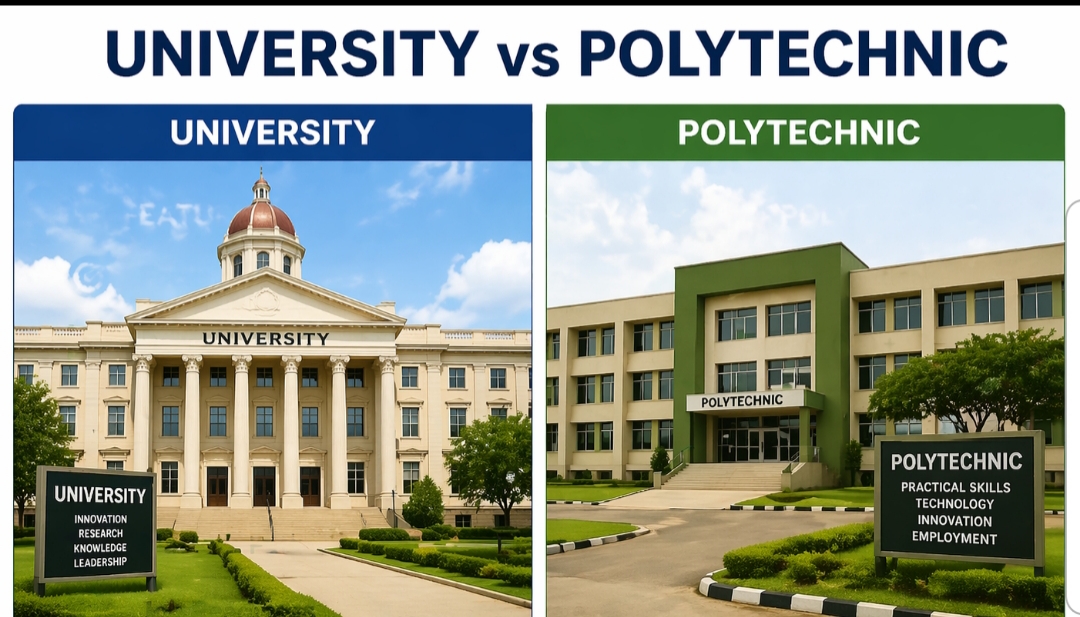
Choosing between a university and a polytechnic in Nigeria is a decision that can shape your career, earning potential, and long-term opportunities. Many students rush this choice based on trends, peer pressure, or half-baked information, only to later regret.
This article breaks down the real differences between universities and polytechnics, using updated context, and clear comparisons to help students in decision of whether to go for university or polytechnic
What Is the Core Difference?
The difference is simple:
– Universities focus on theory, research, and in-depth academic rigor.
– Polytechnics focus on practical skills, technical training, and industry readiness
But that’s just the surface. On a more deeper level a lot of other factors distinguishes the duo:
1. Duration of Study
The time you spend in school varies significantly.
University
The duration depends on your course:
– 3–4 years: Arts, Social Sciences
– 4–5 years: Engineering, Sciences
– 6–7 years: Medicine and Surgery, Law
This flexibility reflects the academic depth required in different fields.
Polytechnic
Polytechnics follow a structured path:
– 2 years: National Diploma (ND)
– 1 year: Industrial Training (IT)
– 2 years: Higher National Diploma (HND)
Total of 5 years
This system allows students to earn a qualification midway and decide whether to continue or enter the workforce.
2. Courses and Career Options
University
Universities offer wider range of disciplines:
– Medicine and Surgery
– Law
– Engineering
– Science
– Social Sciences
– Arts and Humanities
– Business and Finance
If the career path you want to choose requires professional licensing or advanced academic study, then a university is mandatory.
Polytechnic
Polytechnics focus on:
– Engineering Technology
– Computer Science / IT
– Business Administration
– Applied Sciences
– Technical and Vocational Courses like Welding and fabrication technology, plumbing and pipe fitting, electrical installation and maintenance, carpentry, catering and hotel management, automotive mechatronics etc
You won’t find courses like Medicine or Law here, but you’ll gain skills that are directly applicable in the job market.
3.Master’s Degree
University
If you graduate with at least a Second Class Lower:
– You can apply directly for a Master’s degree (MSc, MA, MBA, etc.)
This makes academic progression faster and more straightforward.
Polytechnic
With an HND:
– You cannot go directly to a Master’s program
– You must first complete a Postgraduate Diploma (PGD)
While this adds an extra step, many students successfully transition and even outperform their university counterparts later.
4. Admission Process
University (One-Time Admission)
– Write UTME
– Gain admission once
– Stay in the system until graduation
No need to reapply midway.
Polytechnic (Two-Stage Admission)
– Gain admission into ND
– Graduate and apply again for HND
This means:
– Two applications
– Possible uncertainty between stages
However, it also gives flexibility if you want to pause or change direction.
5. Early Job Opportunities
University
– You typically wait until graduation to use your degree formally
– SIWES (industrial training) exists but doesn’t equal certification
Polytechnic
-After ND (2 years), you already have a certificate, you can:
– Start working
– Gain experience
– Even fund your HND yourself
ND holders often face lower pay, but experience can offset this over time.
6. Teaching Style: Theory vs Practical
University
– More theoretical and research-based
– Focus on concepts, analysis, and problem-solving frameworks
– Ideal for:
– Academics
– Policy-making
– High-level professional roles
Many employers value skills over certificates and this is where polytechnics often shine.
7. UTME Cut-Off Marks
University
– General minimum: around 160
– Competitive courses: 180–250+
Admission is highly competitive.
Polytechnic
– Lower cut-off marks (often around 120)
– More accessible entry route
This doesn’t mean lower quality, it simply reflects different entry priorities.
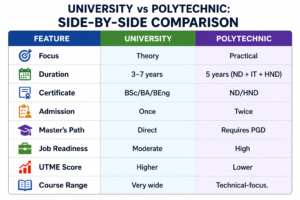
University vs polytechnic chart
Hidden Realities (Polytechnic vs University)
1. HND vs BSc Bias in Nigeria
There is still some bias in the job market:
– BSc holders are often preferred for certain roles
– Some organizations limit HND holders in career progression
However this gap is reducing hence skills, certifications, and experience are becoming more important.
2. Smart Strategy Many Students Use
1. Start with Polytechnic (ND/HND)
2. Gain practical skills + experience
3. Use Direct Entry into University (200 level)
This gives you:
– Practical + theoretical advantage
– Stronger CV than average graduates
3. Entrepreneurship Advantage
Polytechnic graduates often:
– Start businesses earlier
– Have hands-on skills
– Adapt faster in technical industries
University graduates may:
– Earn more in structured careers
– Climb corporate ladders faster
Which Should You Choose
Choose University if you:
– Want to study Medicine, Law, or specialized professions
– Plan to pursue postgraduate studies (MSc/PhD)
– Prefer theoretical and academic learning
– Aim for corporate or professional careers
Choose Polytechnic if you:
– Want practical, hands-on skills
– Prefer learning by doing
– Want to start working earlier
– Are interested in technical or entrepreneurial paths
University may present as a better option but we can’t conclusively say it is better than polytechnic in the sense that both University and polytechnic have their distinct strength and focus.
Before choosing, define your career goal clearly and understand the industry you want to enter.
Think long-term not just admission ease
Also consider combining both paths strategically
Your decision today will influence your life in the next 10–20 years so choose wisely.
To cap it all, know your success is not determined by whether you attend a university or polytechnic but by how well you use the opportunities available to you.
Frequently Asked Questions
1. Is a university degree higher than an HND?
Yes. In Nigeria, a Bachelor’s degree (BSc, BA, BEng) is generally considered higher than a Higher National Diploma (HND). This affects job opportunities and career progression in some organizations, although the gap is gradually reducing.
2. Can an HND holder go for a Master’s degree?
Not directly. HND holders are usually required to first obtain a Postgraduate Diploma (PGD) before applying for a Master’s degree.
3. Can polytechnic graduates enter university?
Yes. Polytechnic graduates can use their ND or HND to gain admission into universities through Direct Entry (DE), starting from 200 level.
4. Can I study Medicine or Law in a polytechnic?
No. Polytechnics in Nigeria do not offer professional courses like Medicine and Surgery or Law. These are only available in universities.
5. Do polytechnic graduates get jobs easily?
Polytechnic graduates often have strong practical skills, which can make them job-ready but some employers still prefer university degrees for certain roles. Skill level, experience, and certifications can significantly improve job prospects.
6. Is polytechnic more practical than university?
Yes. Polytechnic education focuses more on hands-on training, workshops, and real-world applications, while universities focus on theory and research (though practical work is still included but not as much as poly).
7. Do polytechnic students write JAMB twice?
No. They write JAMB to gain admission into ND. After that, admission into HND usually requires a separate application process, but not another JAMB exam.
8. Is polytechnic cheaper than university?
Yes. Polytechnic tuition fees are lower than university fees, so basically it is a more affordable option for many students.
9. Can I switch from polytechnic to university?
Yes. Many students start in a polytechnic (ND/HND) and later transfer to a university through Direct Entry into 200 level to complete a degree.
10. Do companies still discriminate against HND holders?
Some organizations in Nigeria still show preference for degree holders, especially in promotions and management roles. However, this is changing as skills and experience become more valued.
11. Can a university student be more practical than a polytechnic student?
Yes if the student actively seeks internships, projects, and real-world experience. The institution matters, but personal effort matters more.
12. Is Industrial Training (IT) compulsory in polytechnics?
Yes. IT (also called SIWES) is a mandatory one-year program to give students real industry experience.
I remember how I checked my JAMB CAPS almost on a daily basis to see if I have been offered admission and it wasn’t long before I saw the “congratulations” message. This stretches the importance of JAMB CAPS because you can: Check your admission status Accept or reject admission Monitor admission progress Confirm transfer approval…
There are 74 federal universities in Nigeria including the ones approved in 2025/2026. This list of federal universities and courses follows no actual order but are randomly choosen. Hence only the most popular and most sought after federal universities are included, outlining the departments under every single faculty. Table of contents 1. University of Lagos…
The Nigerian Police Academy (POLAC) is a federal institution established in 1988 to train future officers of the Nigeria Police Force. The academy combines academic education with police and paramilitary training. To gain admission into POLAC involves more than just passing JAMB. Candidates must also meet physical, medical, and character requirements before they can be…
Starting university is one of the biggest transitions in a young person’s life. The university environment is more than just classrooms and lectures. it is a community filled with people from different cultures, backgrounds, lifestyles, and ways of thinking. For every student preparing to enter the university, there are important things you need to get…
The best university to study Medicine and Surgery in Nigeria is the University of Ibadan (UI). It consistently ranks number in Nigeria for Medicine according to several global and national rankings. Apart from global and national rankings many other things sets University of Ibadan apart as the best university to study medicine and surgery in…
Harvard is undoubtedly the best medical university in America because it doesn’t just teach medicine, it creates medicine. Is Harvard the best for everyone? Absolutely not. If you want lower cost, public schools may be smarter If you want less pressure, Havard medical school may not be ideal But if your goal is to be…